Most Canadians Now Believe There Is No Good Time to Buy a House

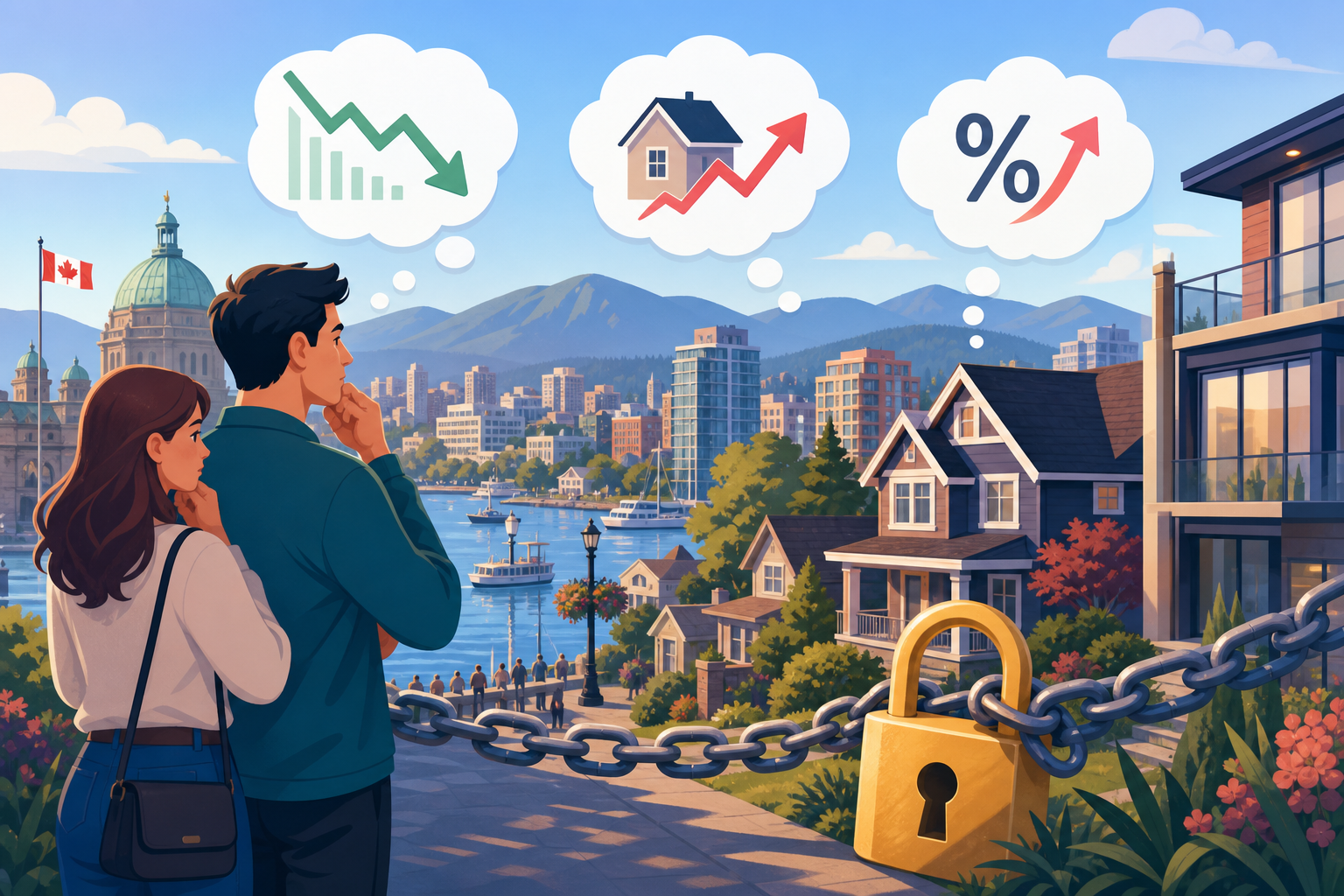
RBC's latest poll landed last month with a finding that sounds obvious but cuts deeper than it looks. Roughly 60% of Canadians now believe there is no good time to buy a house. Not "the timing is difficult." Not "conditions are challenging." No good time, full stop.
That's not skepticism about a market cycle. It's resignation about the market itself.
The Window That Closed
The usual calculus used to be: rates drop, you jump. Prices soften, you act. Wait for the clear signal, then move. That playbook assumed the variables moved in a rhythm you could time. What the RBC data shows is that the variables aren't moving in a rhythm anymore. They're moving against each other in ways that kill every entry point.
Rates came down through late 2024 and early 2025, dipping from the 5%-plus peaks of 2023. That was supposed to open a window. It didn't. Prices in major markets stayed elevated or ticked back up as soon as the rate cuts started. Anyone waiting for a soft-rate, soft-price overlap got neither. The expectation of cheaper money pulled demand forward, which meant affordability improved on paper but worsened in practice. A buyer in Vancouver with approval for a $700,000 mortgage at 4.5% could not actually buy a $700,000 house because that house was listed at $820,000 by the time they walked through the door.
The Wait-and-Lose Trade
The standard counter-argument is to wait. Let prices correct. Let rates stabilize. Let the market come to you. That advice made sense in 2008 or 2018. It doesn't make sense when the thing you're waiting for is a simultaneous drop in both borrowing cost and asset price in a supply-constrained market where new builds aren't keeping pace with immigration and household formation.
Between 2022 and 2024, Canada added roughly 1.2 million people, the majority settling in Ontario, B.C., and to a lesser extent Alberta. Housing starts in the same period ran well under what was required to absorb that inflow, even before you account for aging housing stock and the backlog from the prior decade. So the wait-for-the-crash position is a bet that demand destruction from high rates will outweigh persistent undersupply. That bet worked in the U.S. after 2006 because supply had massively overshot. It has not worked here because supply never caught up in the first place.
What Belief Actually Signals
When a majority of people in a poll say there is no good time to buy, they are not making a market call. They are describing a condition where every available option feels like a loss. Buy now, and you're paying too much. Wait, and you risk being priced out entirely or watching rates climb back. Stretch to afford something, and you're leveraged into fragility. Walk away, and you're renting into your 50s in a country where rental stock is even scarcer than owned housing.
The RBC finding is being reported as uncertainty. That's not quite it. Uncertainty is when you don't know which move is correct. This is when you suspect no move is correct, and you're just picking which version of trapped you prefer. That's not a sentiment problem that clears when the Bank of Canada cuts another 25 basis points. It's a structural problem that doesn't resolve without supply moving faster than demand for long enough to matter.
That hasn't happened yet. Nothing in the current pipeline suggests it will.